


A Hot Pants break free download with no strings: 34 samples, 39.4 MB. The break digitised from vinyl at its native tempo, two edits pitched to 174 BPM, fortified versions with extra kick and snare weight layered in, and 16 top shaker loops cut to sit over it. No account, no checkout.
Download the pack →There is no Hot Pants break. Not on any record pressed in 1971, anyway. The two-bar drum loop that jungle, jump up and half of British rave built themselves on does not appear on James Brown's "Hot Pants" and it does not appear, clean, on Bobby Byrd's either. It was made sixteen years later in a London cutting room, from the master tapes, as a throwaway B-side for DJs. Then a Manchester band, a kid from Braintree and most of the jungle scene found it, and the throwaway became one of the most sampled pieces of drumming on earth.
This Hot Pants break free download gives you that loop, prepared properly for drum and bass, and the story of how a drummer from Jackson, Alabama, ended up under a thousand records he never heard. Keep the loop running while you read. It explains itself faster than we can.
▸ Hear what's inside
Thirty-four files, 39.4 MB, in four groups. The first three follow the same logic as the Amen and Think packs. The fourth is new, and it is there because of what this particular break is made of.
The original break. Digitised from vinyl at its native tempo, somewhere around 110 BPM, with the crackle and rumble taken out and the tape left alone. This is the reference. If you only ever use one file from the pack, use this one and do the pitching yourself.
Two 174 BPM edits. The break sped up the old way, by resampling rather than stretching, so it arrives at drum and bass tempo roughly eight semitones brighter than the record. Two versions, two characters. Both lock to the grid the moment you drop them in.
Fortified versions. The same loop with additional kick and snare samples layered over Starks's hits and phase-aligned, plus light processing, so the break holds its own under a modern bassline without a separate drum layer. The groove does not change. The mass does.
Sixteen top shaker loops. The Hot Pants signature is a tambourine shaking sixteenths through the whole loop. These give you that movement on its own, at 174, to run over programmed drums, over the other breaks in this series, or over the pitched Hot Pants itself when you want the top end thicker. Subscribers had this pack months before the site did. The list is where the next one lands first.
Ask three producers where the Hot Pants break comes from and you will get three records, and only one of them is right.
The first is James Brown's "Hot Pants (She Got to Use What She Got to Get What She Wants)", cut at Starday-King in Nashville on 13 May 1971 and released that July as People 2501, on his new People label. Number one R&B, fifteen on the Hot 100, and a hip-hop staple: WhoSampled lists over 240 records built on it. Almost none of them are drum and bass. The drums are great, but they are never alone.
The second is Bobby Byrd's "Hot Pants - I'm Coming, Coming, I'm Coming", the answer record Brown wrote and produced for his oldest friend that summer and put out in August 1971 on Brownstone 45-4203, with "Hang It Up" on the flip. Two minutes twenty-seven. It scraped into the Cash Box chart at 72 and left. This is the record the loop was played on, and WhoSampled counts 47 records sampling it. Also almost none of them drum and bass, because here, too, the drums never get a clean bar to themselves.
The third is "Hot Pants (Bonus Beats)", which did not exist until 1987. It is the Byrd recording with everything stripped off the multitrack except the rhythm section and a few shouts, cut onto a UK 12" as a DJ tool. The count on that one is over 890 and climbing, and that is where the jungle records are. When someone says Hot Pants break, this is what they mean, even if they think they mean 1971.
To understand why a Bobby Byrd B-side has James Brown's drummer on it, you need March 1970. That month most of Brown's band walked out over money, and he replaced them overnight with a Cincinnati group called the Pacemakers, led by two teenagers named Bootsy and Catfish Collins. Those J.B.'s lasted a year. By the spring of 1971 the Collins brothers were gone as well, and Brown rebuilt again around trombonist Fred Wesley, bassist Fred Thomas, guitarist Hearlon "Cheese" Martin and the one man who had stayed through both upheavals: drummer John "Jabo" Starks.
That is the band on Brown's "Hot Pants" in May, and it is the band on Byrd's version a few weeks later. The Byrd single carries no musician credits, only "Written and produced by James Brown", but by that summer Starks was the only drummer the J.B.'s were carrying, and he is the drummer on the Byrd and Lyn Collins sides Brown produced in this period. He is also the drummer on the Think break. Two of the three most-used breaks in jungle, one pair of hands.

Bobby Byrd in a 1969 press photo. He founded the Flames, got James Brown out of a juvenile prison, and sang the "Get on up" on "Sex Machine", then spent 1971 cutting his own singles with Brown's band in the gaps between tours.
Byrd deserved more than a footnote and mostly got one. Born in Toccoa, Georgia, in August 1934, he founded the gospel group that became the Famous Flames, met James Brown at a baseball game at the juvenile detention centre where Brown was serving time, and his family vouched for Brown's release. "Please, Please, Please" followed. So did "Get Up (I Feel Like Being a) Sex Machine", on which the second voice, the "Get on up", is Byrd, playing Hammond at the same time. Brown set up Brownstone Records in 1970 with the Miami distributor Henry Stone, mostly as a home for the people in his revue that King Records would not record. Byrd and his wife Vicki Anderson were the whole roster. It released eleven singles in two years and folded into People.
Byrd left the Brown organisation in 1973. He recorded sporadically, made a comeback album in 1993 once the samples had found him a new audience, and died of cancer in Loganville, Georgia, on 12 September 2007, aged 73. The Famous Flames went into the Rock and Roll Hall of Fame five years later. He was not there to see it.
Starks joined Brown from Bobby "Blue" Bland's band in 1965 and spent five years sharing the drum chair with Clyde Stubblefield. The usual line is that Stubblefield was the loose one and Starks was the disciplined one, and the records bear it out. Stubblefield got "Funky Drummer" and "Cold Sweat". Starks got "Sex Machine", "Super Bad", "Soul Power", "The Payback" and "Doing It to Death", most of the Lyn Collins and Bobby Byrd catalogue, and the two breaks in this series. Questlove has called him Brown's most effective drummer, and traced a straight line from his eight-on-the-floor patterns to New Jack Swing and Baltimore club.
"I'm not trying to outplay anybody else. The only thing I want to do is keep that heartbeat going, as they call it."
- John "Jabo" Starks, WGBH interview, 1995
That sentence is the Hot Pants break. There is no fill, no solo, no moment where the drummer steps forward. Just a heartbeat, held so steadily that you can cut any two bars out of the Bonus Beats and they loop. That is a rarer skill than it sounds, and it is why the break survives being sped up by more than half without falling apart. He died at home in Mobile, Alabama, on 1 May 2018, aged 80.
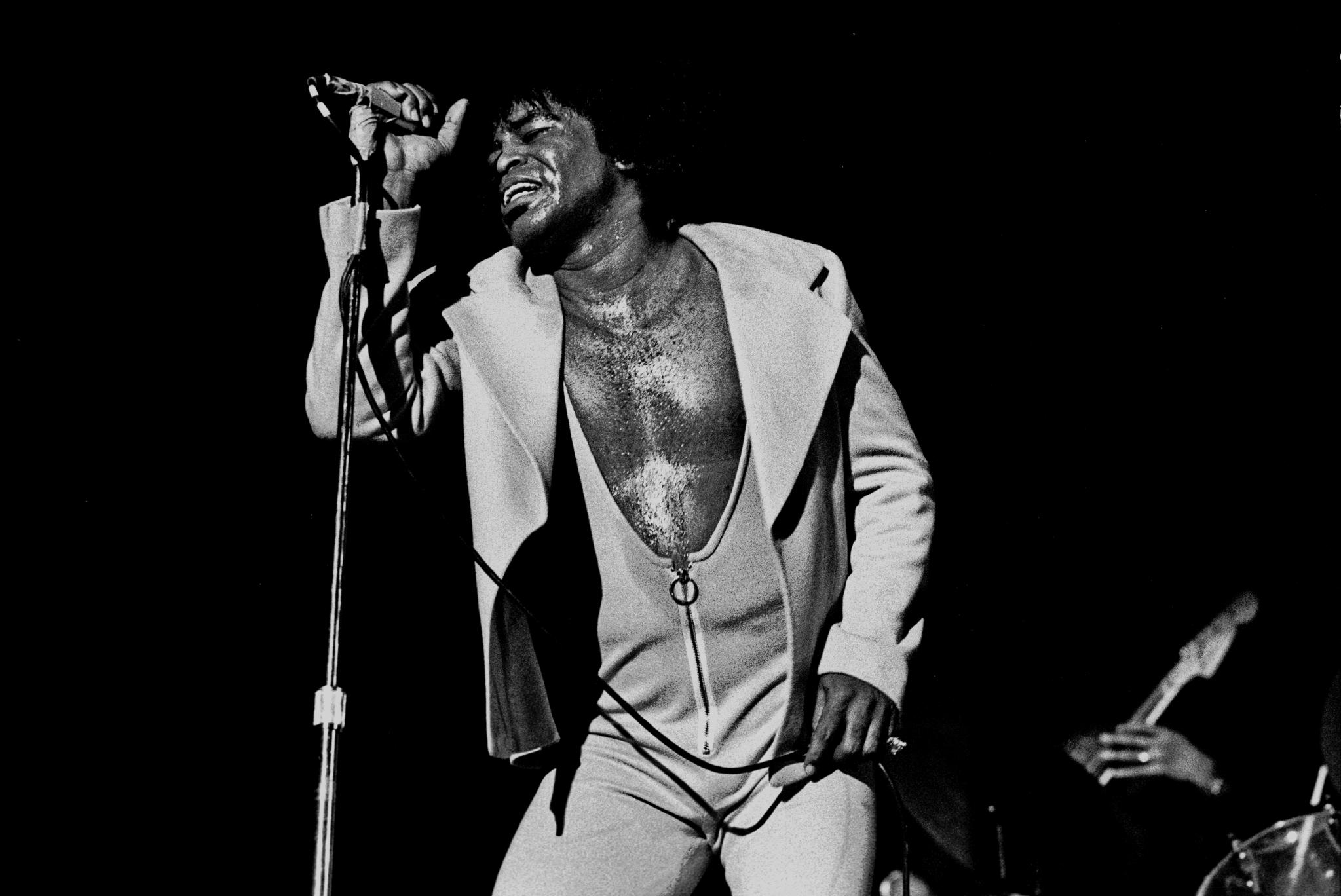
James Brown on stage in Hamburg, February 1973. Fred Wesley, Fred Thomas and Jabo Starks were still in the band. Byrd, who had been there since the Flames, would be gone before the year was out.
The Amen is a four-bar drum solo with a famous fill. The Think is a bar of drums with a famous shout. The Hot Pants is neither. It is a rhythm section playing the song, with the song removed, and that changes how you use it.
Loop two bars of the Bonus Beats and listen from the bottom up. The kick is a 1971 funk kick, round and soft, with no click and no sub. It lands on the one and doubles up once a bar, which is the only syncopation the pattern has. The snare sits tight on two and four, dry enough to chop, with just enough room on it to tell you a person hit it. There is a second, lighter snare stroke in there that most producers leave alone and the best ones use. Over the top, whatever hi-hat Starks is playing is buried under a tambourine shaking straight sixteenths from the first beat to the last. On Brown's own "Hot Pants" the tambourine credit is Byrd himself. On the Bonus Beats it is the loudest thing in the mix.
That tambourine is the whole character of the break, and both of its problems. Pitch the loop up eight semitones and the sixteenths turn into a fine hiss sitting around 8 to 12 kHz, which is the sizzle on every jungle record that used it. It also means every single sixteenth of the loop has tambourine on it, so there is no such thing as a clean Hot Pants one-shot. Slice a kick out and you get a kick with a tambourine tail. The Amen and Think both chop into one-shots. The Hot Pants wants to stay a loop, or be cut at whole beats, and the sixteen top loops in this pack exist so you can have the movement without the bleed when you need to.
The other thing to notice is what is not there. No fill. No turnaround. Nothing that tells you where bar one is. A weakness if you want drama, a strength if you want a break to sit under a jump up bassline for sixteen bars without drawing attention to itself, which is why the Hot Pants became the workhorse it did. For why some grooves loop invisibly and others fight the grid, our guide to drum programming fundamentals covers ghost notes and micro-timing in detail.
By 1986 James Brown's catalogue was the raw material of hip-hop and nobody in the UK could buy the records. Polydor's answer was a reissue imprint called Urban, where Cliff White and Tim Rogers compiled In the Jungle Groove in August 1986, with the first album release of "Funky Drummer", and James Brown's Funky People the same year. Then in 1987 Eric B. & Rakim built "I Know You Got Soul" on Byrd's 1971 single of the same name, and by early 1988 it was at number 13 in the UK. Urban did the obvious thing and reissued Byrd's original as a 12", catalogue URBX 8.
The B-side is where the history turns. Rogers, credited as remixer, went back to the Hot Pants master tapes, stripped away the vocal and most of the band, and cut what was left onto the flip as "Hot Pants (Bonus Beats)". Bonus beats were a standard late-eighties 12" courtesy: a drums-only pass so DJs could extend a mix or scratch over it. Nobody was thinking about samplers. But what landed in the shops was a clean, exposed Jabo Starks groove at 110 BPM with the tambourine right up front and the odd Byrd shout left in. The sample starts eight seconds in. It has not stopped since.
The first big record to use it was not a dance record. In 1989 The Stone Roses turned up at Sawmills studio in Cornwall with the loop on a record, and producer John Leckie copied it into an Akai S1000 and spent ages tuning it to tempo before Reni played across it. The band always said the loop was "Funky Drummer". It was not. As Overmono put it in their own list of favourite breaks, it is almost impossible to hear the Bonus Beats and not hear "Fools Gold".

The jungle-era shortcut: play the 33 rpm Bonus Beats at 45 and push the pitch to +8, and 110 BPM lands at about 160 without touching a sampler's timestretch.
Rave got it next. Rebel MC in 1990, a kid from Braintree called Liam Howlett in 1991, Orbital in 1992, and then the 1993 hardcore wave took it up past 160 BPM, which from 110 is six and a half semitones. The tambourine hiss joined the Amen's ride wash and the Think's needling hats in the jungle palette and stayed there. LTJ Bukem's "Music" sits on it. Nino Brown's "Signal" (1996), Squarepusher's "Come On My Selector" (1997) and, by most accounts, Adam F's "Metropolis" all lean on it. It never left: Sub Focus built "Original" on it for RAM in 2013, Reso used it on "Break 'Em" for Hospital a year later, Coco Bryce was still cutting it up on "Daktari" in 2022, and it is under Madonna's "Frozen", which is a sentence we did not expect to write either. Six of the records that mattered most:
The Stone Roses, "Fools Gold" (1989)
Released 13 November 1989 on Silvertone, nine minutes fifty-three on the 12", UK number eight. Reni played over the loop on a Noble & Cooley snare. The band said "Funky Drummer". The drums say Hot Pants.
Rebel MC, "Better World" (1990)
Hot Pants under a reggae MC on Desire Records, before jungle had a name. As Congo Natty, the same man would spend thirty years proving the pairing was no accident.
The Prodigy, "Charly" (1991)
August 1991, XL, UK number three, built around a public information film about a cat. The "Trip Into Drum and Bass Version" that opens Experience runs on the Bonus Beats from six seconds in, and "Music Reach" on the same album uses it again.
Orbital, "Halcyon" (1992)
The break pitched up and smoothed out under one of the most-loved pieces of British electronic music. A 1971 funk B-side carrying a comedown as well as a drop.
Plug, "710" (1995)
Luke Vibert on Rising High, chopping the loop into the fractured drill that would later be filed under "drill and bass". The break at its most abused.
DJ Die & Roni Size, "Drop Bear" (1999)
Full Cycle, end of the decade. The Hot Pants the Bristol way: a rolling bed with programmed drums on top and the tambourine supplying the sixteenths.
The break asks for a different workflow from the Amen. You are not chopping a solo into hits and resequencing it. You are taking a two-bar groove and making it sit. Here is the order that works.
▸ Build stepsPick the version for the job
Jungle and anything period-correct: start from the original and pitch it yourself. Jump up and modern rollers: the fortified versions, which already carry the kick and snare weight a 1971 kit does not have. Liquid: the pitched edits under your own programmed drums, or just the top loops.
Pitch, don't stretch, and go in two moves
From 110 to 174 is a stretch ratio of 1.58, and stretching that far smears every transient and turns the tambourine into a flange. Pitch instead. If the eight-semitone snare clashes with your bass note, go up seven semitones to 165 BPM first, which is an exact fifth, then stretch only the remaining 5 percent or so to 174. A 5 percent stretch is inaudible. A 58 percent one is not.
Put a sub kick under the first kick
The move every jungle producer made with this break: an 808 or a clean synthesised sub kick aligned to Starks's downbeat kick, not to the bar start. High-pass the break itself at 100 Hz so the two kicks never fight. Our guide to layering drums for weight and impact covers the sample-level alignment.
Tame the tambourine, then feed it back
Pitched up, the tambourine piles up between 8 and 12 kHz. A shelf down 3 dB from 9 kHz calms it without dulling the snare. Then, if the top end feels thin, add one of the sixteen top loops back in, high-passed at 2 kHz and 10 dB under the break. You get the sixteenths back at a level you control, without the bleed.
Compress for the ghost strokes
Parallel compression, 4:1, attack around 30 ms so the main hits pass through, release fast enough to reset by the next sixteenth. Blend to taste. The lighter snare stroke and the kick's second hit come forward and the loop starts to breathe. Then stop. The break is a heartbeat, and you cannot improve a heartbeat by doing more to it.
One more thing. The 1971 recording has a rights holder and the 1987 mix has a label behind it, and a free download does not change either fact. Hundreds of records used the Bonus Beats without clearance and almost none were pursued, but that is a description of history, not a licence. Before a commercial release, read our guide to sample copyright for producers and make the call with your eyes open.
Thirty-four files: the break from vinyl at its native tempo, two 174 BPM pitched edits, fortified versions with modern weight, and sixteen top shaker loops. Free, and it always will be.
Download the pack →
At KAN Samples, our mission is to preserve the rich history of Drum & Bass while helping producers shape its future.
Through free resources, classic break restorations, and professional-grade sample packs, we aim to empower artists at every level with tools that inspire creativity and respect the roots of the genre.


Leave a comment